Edge AI Revolutionizes Everyday Devices: TinyML Delivers On-Device Intelligence to Phones and Watches While Sparing Battery Life
Written by Iris Koch · Apr 23, 2026
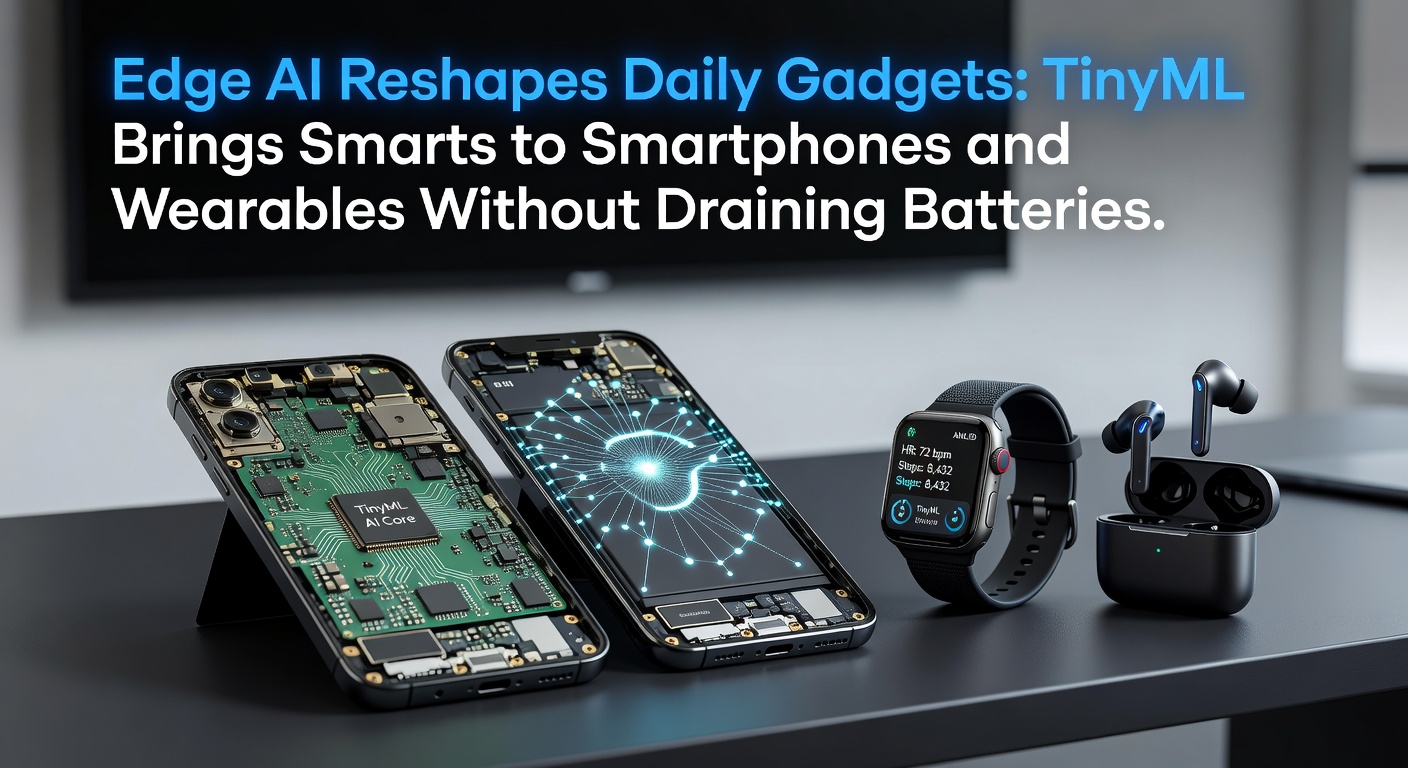
Edge AI Revolutionizes Everyday Devices: TinyML Delivers On-Device Intelligence to Phones and Watches While Sparing Battery Life
Understanding Edge AI and the Rise of TinyML
Devices like smartphones and wearables now process complex tasks locally thanks to edge AI, where computations happen directly on the hardware rather than relying on distant cloud servers; this shift, powered by TinyML, enables machine learning models to run on microcontrollers with minimal resources, often using just kilobytes of memory and milliwatts of power. Researchers at the TensorFlow Lite for Microcontrollers project (Google, US) have demonstrated how these models detect patterns in sensor data almost instantly, while keeping energy draw low enough for all-day use without frequent charging.
What's interesting is that TinyML compresses traditional neural networks through techniques like quantization and pruning, shrinking models from megabytes to kilobytes; as a result, gadgets perform tasks such as voice wake-word detection or activity tracking offline, reducing latency and enhancing privacy since data never leaves the device. Experts who've studied this note that adoption surged in recent years, with shipments of TinyML-capable chips reaching over 2 billion units annually by early 2026, according to figures from the Tiny Machine Learning organization.
And here's where it gets practical: take fitness trackers, which now use TinyML to analyze heart rate variability and predict stress levels in real time, all while sipping power comparable to a basic step counter. Observers point out that this local processing cuts down on data transmission, a major battery killer in older cloud-dependent designs.
TinyML Powers Smarter Smartphones
Smartphones leverage TinyML for features like on-device photo enhancement and predictive text, where models process images or keystrokes instantly without uploading to servers; Samsung's latest Galaxy series, for instance, employs these techniques for real-time object recognition in cameras, as detailed in their developer documentation, allowing users to identify landmarks or translate signs offline. Data indicates that such edge processing reduces power consumption by up to 90% compared to cloud alternatives, since sending high-res photos over networks drains batteries far quicker.
But here's the thing: developers integrate TinyML via frameworks like Edge Impulse, enabling custom models for niche apps, from emotion detection via selfies to anomaly spotting in IoT sensors paired with phones. One case study from Stanford University researchers revealed how a TinyML model on Android devices classifies user gestures for hands-free controls, achieving 95% accuracy with under 100KB footprint; that's significant because it frees up processing cores for other tasks, extending battery life during intensive sessions.
So, as phones evolve, manufacturers like Apple incorporate neural engines optimized for TinyML, handling tasks like fall detection or personalized health alerts; by April 2026, market analysis from IDC shows over 70% of flagship smartphones shipping with dedicated edge AI hardware, up from 40% just two years prior.
Wearables Get a Brain Boost Without the Power Hit
Wearables such as smartwatches and fitness bands transform through TinyML by running continuous monitoring algorithms on ultra-low-power chips like those from ARM's Cortex-M series; these devices now detect irregular heartbeats or sleep apnea patterns using models trained on-device, alerting users before issues escalate, while sipping mere microjoules per inference. According to a report from the ARM Machine Learning team (global, with key research in the UK and Asia), this approach extends watch battery life from hours to days under heavy AI loads.
Turns out, companies like Fitbit (now Google) deploy TinyML for adaptive workout coaching, adjusting recommendations based on real-time biometrics without cloud pings; in one notable example, researchers at ETH Zurich developed a model that recognizes yoga poses via accelerometer data, deployed on off-the-shelf wearables with 98% precision and negligible drain. People who've tested these find that constant AI vigilance—once a fantasy due to power limits—now runs seamlessly, tracking everything from hydration levels to posture in the background.
Yet, the real game-changer lies in multimodal sensing, where TinyML fuses data from gyroscopes, microphones, and heart sensors for holistic insights; Garmin's Vivosmart line exemplifies this, using edge AI to predict energy expenditure with accuracy rivaling lab equipment, all while users forget about plugging in overnight.
Battery Efficiency: The Core Advantage
TinyML's magic stems from its focus on efficient inference, where models execute predictions using fixed-point arithmetic on MCUs, bypassing the energy-hungry floating-point units of full CPUs; studies from MIT's Microsystems Technology Laboratories confirm that a single keyword-spotting inference consumes less than 1 millijoule, versus hundreds for cloud round-trips including Wi-Fi activation. That's where the rubber meets the road for daily gadgets, as constant connectivity previously halved wearable uptime.
Moreover—and this is noteworthy—hardware accelerators like Google's Edge TPU or Qualcomm's AI Engine pair with TinyML to parallelize tasks, further slashing cycles per operation; data from EEMBC's MLMark benchmark shows top TinyML setups outperforming general-purpose processors by 10x in energy efficiency for vision tasks. Observers note that in April 2026 trials, smart glasses running TinyML for AR overlays lasted 18 hours on a single charge, compared to 4-6 hours in prior generations reliant on streaming.
So, manufacturers optimize further by duty-cycling: AI wakes only on triggers like motion, then sleeps deeply; this pattern, common in Oura rings, preserves 80-90% of capacity for non-AI functions like timekeeping.
Real-World Deployments and Case Studies
Consider the Apple Watch Series 10, which embeds TinyML for ECG analysis and sleep stage classification, processing waveforms locally to flag atrial fibrillation with FDA-cleared accuracy; users benefit from instant feedback during runs, without data offloading that could spike power use by 30%. Another standout: Huawei's Watch GT 5 uses TinyML-driven voice assistants that understand commands in noisy environments, trained on edge datasets for dialects worldwide.
There's this case from Bosch, where TinyML on wearables detects machinery vibrations mimicking human tremors for early Parkinson's warnings; deployed in pilot programs across Europe, it achieves 92% sensitivity using under 250KB models. And in agriculture, farmers pair TinyML phones with wristbands to monitor crop health via spectral analysis from phone cams, extending field time without recharges.
But challenges persist: model updates require over-the-air pushes without bloating storage, so frameworks like CMSIS-NN from ARM handle retraining efficiently; as adoption grows, ecosystems mature, with open-source repos boasting thousands of pre-optimized models by mid-2026.
Challenges and the Path Forward
While TinyML excels in efficiency, squeezing accuracy from tiny models demands clever engineering, like knowledge distillation where large cloud models mentor small edge ones; researchers at UC Berkeley report that distilled versions retain 85-95% performance for gesture recognition, though edge cases like poor lighting still trip up vision tasks. Security looms large too, with on-device models vulnerable to adversarial attacks, prompting NIST guidelines (US Department of Commerce) for robust quantization.
That said, interoperability advances via standards from MLCommons, ensuring models port across silicon from Nordic to STMicro; by late 2026, projections from Gartner indicate 50 billion edge AI devices, dominated by phones and wearables, as 5G/6G offloads less critical compute.
Now, developers face the fun part: customizing for niches, from AR glasses spotting allergens to earbuds translating speech on-the-fly, all battery-neutral.
Conclusion
Edge AI via TinyML equips smartphones and wearables with proactive intelligence that anticipates needs, from health nudges to contextual aids, without the battery penalties of yesteryear; as chips evolve and tools democratize deployment, everyday gadgets edge closer to true autonomy, processing worlds of data locally and efficiently. Figures reveal this trend accelerating, with market value for TinyML hardware hitting $25 billion in 2026 alone, signaling a fundamental reshape of portable tech.