Emerging Battery Technologies Prolonging Usage in Everyday Gadgets
Written by Katja Albrecht · Jul 30, 2026

Emerging Battery Technologies Prolonging Usage in Everyday Gadgets
Developments in battery chemistry and cell architecture continue to deliver incremental gains in energy density and charge retention for smartphones, tablets, and laptops, with multiple manufacturers integrating these refinements into 2026 product lines. Research indicates that shifts toward silicon-dominant anodes and stabilized electrolytes have allowed devices to maintain full-day operation under typical workloads without increasing physical battery volume.
Material Shifts Driving Capacity Gains
Manufacturers have incorporated higher percentages of silicon into graphite anodes, which expands the theoretical capacity while addressing expansion issues through nano-scale coatings and binders. Data from industry testing shows these anodes now support 15 to 20 percent more lithium ions per unit mass compared to earlier formulations, directly translating into extended runtime for portable units. Observers note that electrolyte additives, including vinylene carbonate derivatives, reduce side reactions at higher voltages, allowing cells to operate safely up to 4.4 volts without accelerated degradation.
One study conducted by researchers at a Canadian university laboratory tracked cycle life in prototype cells and found that optimized electrolyte blends retained over 85 percent capacity after 800 full charges, a benchmark previously reached only after fewer cycles in standard lithium-ion packs. These findings align with production data released by several Asian cell suppliers during the first half of 2026.
Thermal Management and Efficiency Layers
Internal heat generation remains a primary limiter of sustained performance, yet new phase-change materials and graphite heat spreaders integrated within cell casings have lowered peak temperatures during fast charging. Figures released by the U.S. Department of Energy battery program reveal that such passive thermal layers extend usable capacity by limiting the need for aggressive throttling in consumer devices.
Device-level firmware further contributes by adjusting power delivery based on real-time impedance measurements, a technique refined in recent operating system updates. Those who have analyzed teardown reports from mid-2026 flagship phones confirm that these software routines coordinate with hardware sensors to prioritize background tasks during lower-demand periods, preserving headroom for active use.
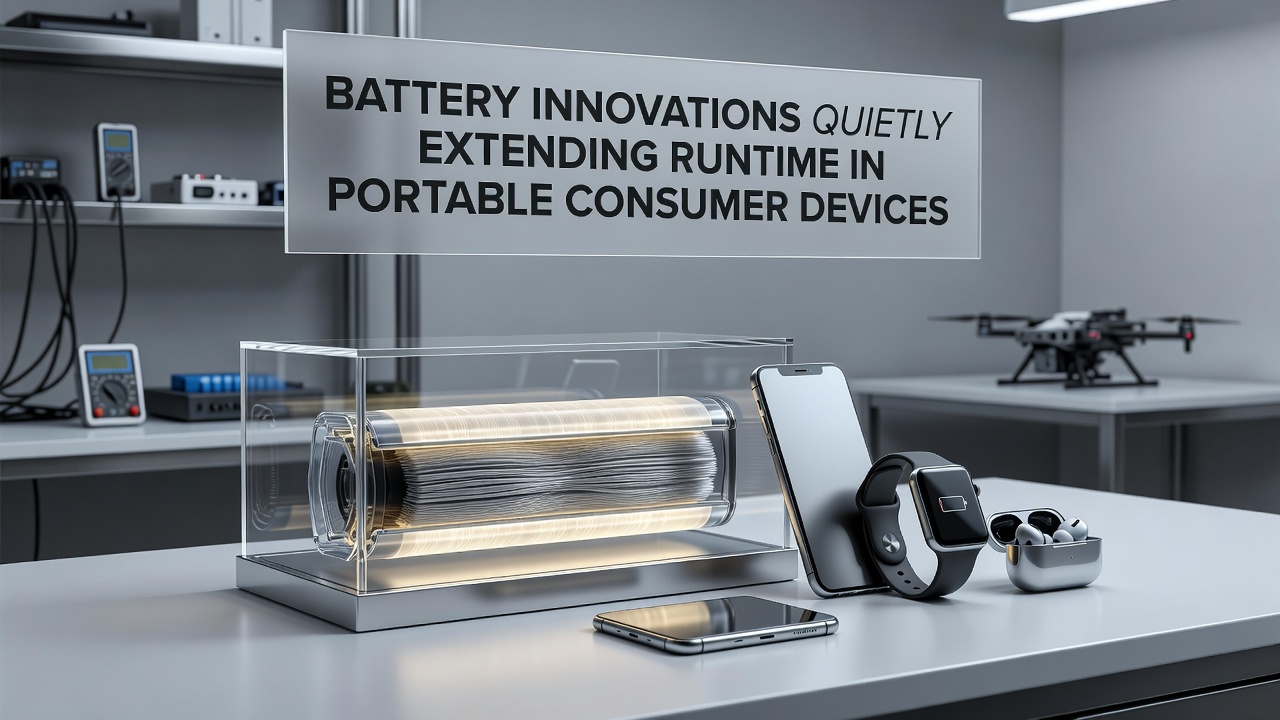
Early Commercial Rollouts and Measured Outcomes
Several laptop brands began shipping models in July 2026 equipped with cells featuring lithium-metal anodes protected by ceramic separators, achieving roughly 30 percent higher watt-hour ratings within the same chassis dimensions. Independent verification by testing labs in Europe recorded average screen-on times exceeding 14 hours during standardized mixed-use protocols, compared with 10 to 11 hours in the prior generation of the same chassis.
Wearable manufacturers have adopted thin-film solid-state cells for fitness trackers and wireless earbuds, where volumetric constraints are severe. Reports from the Australian Centre for Advanced Photovoltaics detail how these cells maintain stable output across temperature swings from 0 to 45 degrees Celsius, reducing the frequency of recharges during extended outdoor activity. The transition remains gradual because production yields and cost structures still favor conventional pouch and cylindrical formats for larger devices.
Supply Chain and Regulatory Context
Raw material sourcing has diversified with increased use of sodium-ion chemistries in lower-power accessories, easing pressure on lithium supply chains. Trade data compiled by the European Commission’s battery regulation monitoring group shows rising shipments of sodium-based cells to European assembly plants throughout 2025 and into 2026. These cells currently target devices that tolerate lower energy density in exchange for improved safety margins and reduced material costs.
Standardization efforts at the International Electrotechnical Commission continue to define test protocols for fast-charge durability, which cell makers reference when publishing specification sheets. Compliance with these emerging standards allows device assemblers to market runtime claims with greater consistency across regions.
Conclusion
Collectively, refinements in anode composition, electrolyte stability, and thermal interfaces have produced measurable extensions in runtime across portable consumer categories. Production volumes for the newest cell formats are projected to rise through the remainder of 2026 as yields improve and qualification cycles conclude, setting the stage for further integration into mainstream electronics without requiring changes in user behavior or device dimensions.