Hardware Requirements Fueling New AI Functions in Handheld Gadgets
Written by Yara Washington · Jul 18, 2026

Hardware Requirements Fueling New AI Functions in Handheld Gadgets
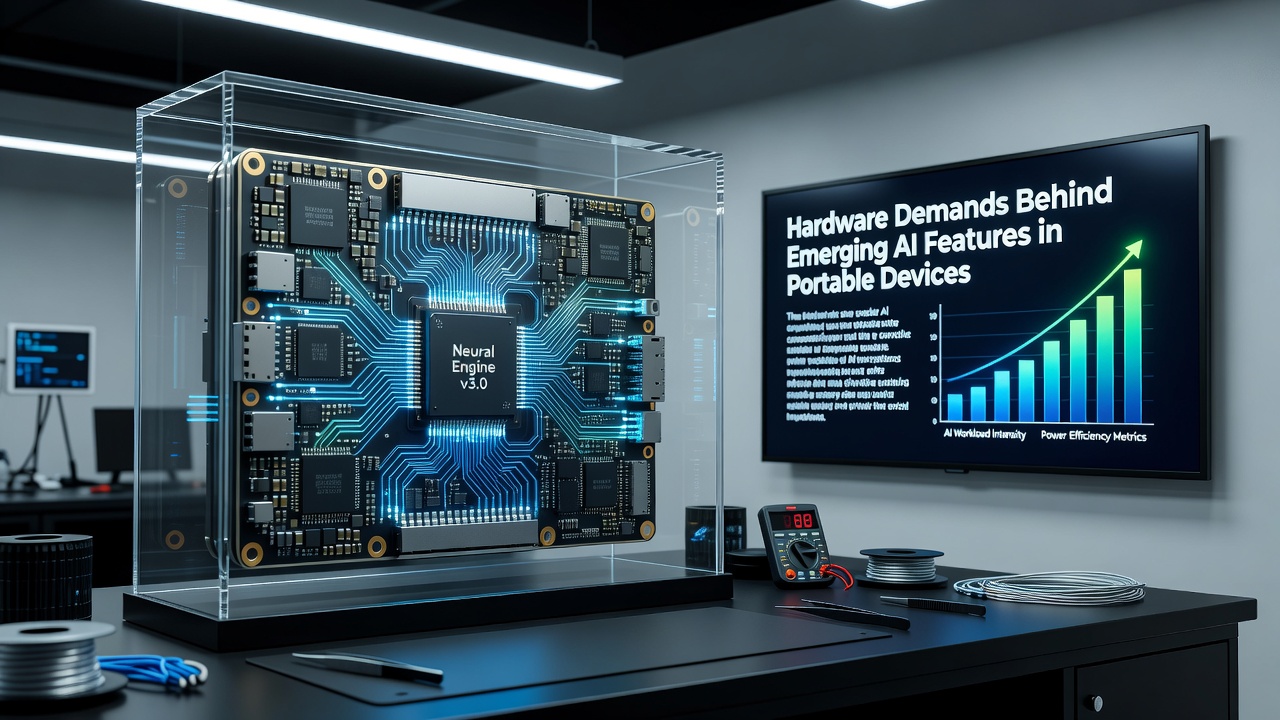
Portable devices now integrate AI features that range from real-time language translation to generative image creation, and these capabilities rest on specific hardware upgrades that manufacturers have rolled out in recent years. Research from industry analysts shows that neural processing units, increased RAM allocations, and advanced power delivery systems form the core of these implementations, while data from chipmakers indicates steady growth in transistor density and specialized accelerators since 2023.
Manufacturers embed NPUs directly into system-on-chip designs to handle machine learning inference locally, which reduces reliance on cloud connections and cuts latency for tasks such as voice command processing or photo enhancement. According to figures released by the Semiconductor Industry Association, shipments of chips with dedicated AI accelerators reached 1.2 billion units globally in 2025, a trend that continued into July 2026 with new mid-range smartphones incorporating at least 10 TOPS of NPU performance.
Processor Architectures Supporting On-Device Inference
Modern mobile processors combine central processing units, graphics processing units, and neural engines on the same die, yet each component serves distinct roles during AI workloads. Central cores manage orchestration and data movement, graphics units tackle parallel matrix operations, and neural engines execute quantized models with minimal energy draw. Observers note that Apple’s A-series and M-series chips, along with Qualcomm’s Snapdragon X Elite line, allocate up to 40 percent of die area to these accelerators, a layout that enables sustained operation of large language models under 7 billion parameters without external servers.
European researchers at the Technical University of Munich published findings in early 2026 that quantified energy costs for running transformer models on different silicon nodes. Their measurements revealed that inference on a 4-nanometer process consumed 35 percent less power than equivalent workloads on 7-nanometer designs, prompting several Asian and North American vendors to accelerate migration to smaller geometries.
Memory Bandwidth and Capacity Constraints
AI models require rapid access to weights and activations, which places pressure on both DRAM capacity and memory bus speeds. Devices released after 2024 commonly feature 12 to 16 gigabytes of LPDDR5X or LPDDR6 memory paired with 68-bit or wider interfaces that deliver over 100 gigabytes per second of bandwidth. Studies conducted by the University of Waterloo’s hardware laboratory demonstrate that doubling memory bandwidth can reduce token generation time by 28 percent for a 3-billion-parameter model running entirely on the device.
Storage subsystems have also evolved to accommodate larger model files and frequent checkpoint writes during fine-tuning sessions. UFS 4.0 controllers paired with high-endurance NAND now appear in flagship tablets and foldables, delivering sequential read speeds above 4,000 megabytes per second that keep model loading times under two seconds.
Power Delivery and Thermal Engineering
Battery capacities in portable electronics have grown modestly to around 5,000 milliamp-hours, yet voltage regulators and power management integrated circuits must supply clean, high-current rails to multiple voltage domains simultaneously. Data from the U.S. Department of Energy’s 2025 efficiency report indicates that AI-specific power states can draw peak currents exceeding 15 amperes for brief intervals, requiring multi-phase buck converters with sub-milliohm resistance.
Thermal throttling remains a limiting factor during extended generative tasks. Engineers therefore deploy vapor chambers, graphite sheets, and sometimes microfluidic channels that maintain junction temperatures below 85 degrees Celsius. Australian testing facilities documented in June 2026 that optimized cooling stacks extended sustained AI performance windows by 45 percent compared with passive graphite-only designs.
Software-Hardware Co-Design Trends
Operating systems now expose low-level APIs that allow applications to partition models across available accelerators, and this co-design approach maximizes utilization while respecting thermal budgets. Frameworks such as Android’s ML Kit and Apple’s Core ML compile models to hardware-specific formats that exploit INT8 or FP16 precision, cutting both memory footprint and computation time.
Security modules integrated alongside NPUs enforce model encryption and attestation, ensuring that sensitive weights remain protected during local execution. Government cybersecurity guidelines published by Canada’s Communications Security Establishment in 2025 recommend hardware-backed key storage for any device handling on-device AI, a practice adopted by several major smartphone vendors by mid-2026.
Conclusion
Hardware demands for emerging AI features in portable devices center on specialized accelerators, expanded memory subsystems, efficient power delivery networks, and advanced thermal solutions that together enable responsive, private computation. Figures released through July 2026 confirm continued scaling of these components across price tiers, driven by both consumer expectations and regulatory emphasis on data localization.