Mapping Information Routes Across Distributed Cloud Network Systems
Written by Quinn Lange · May 30, 2026
Mapping Information Routes Across Distributed Cloud Network Systems
Modern enterprises rely on intricate webs of virtual networks, storage systems, and compute resources spread across multiple providers, and tracing how information moves through these layers requires specialized tools and techniques that capture every hop and transformation along the way. Observers note that organizations began expanding their use of hybrid setups significantly after 2023, which increased the need for precise pathway analysis to maintain performance and meet regulatory requirements.
Core Components of Cloud Data Movement
Cloud infrastructure consists of virtual private clouds, load balancers, content delivery networks, and interconnects that direct packets between regions and availability zones, while each element adds its own metadata and routing decisions that affect the overall journey of a data packet. Researchers discovered that flow logs from services such as Amazon VPC or Google Cloud VPC combined with packet mirroring capabilities allow teams to reconstruct sequences without disrupting production workloads, and these records capture source addresses, destination ports, and byte counts that reveal patterns over time.
Service meshes introduce additional visibility layers through sidecar proxies that record request latencies and error rates at the application level, whereas traditional network taps only see the underlying transport details. Data indicates that adoption of these meshes grew steadily because they provide correlation between infrastructure metrics and business transaction outcomes, and this correlation proves essential when troubleshooting issues that span several microservices running in different accounts.
Techniques and Tools for Pathway Reconstruction
Distributed tracing frameworks such as OpenTelemetry collect span data that tags each segment of a request with unique identifiers, and these spans link together to form complete traces that show how a single user action triggers operations across databases, caches, and external APIs. Teams often deploy agents that export this information to centralized collectors, and the resulting datasets support queries that filter by time windows or error conditions.
Network flow analysis supplements tracing by examining aggregated records from routers and switches, while machine learning models applied to these flows can flag anomalous routes that deviate from established baselines. Experts have observed that combining flow data with tracing produces richer insights than either method alone, because infrastructure-level details explain why an application-level delay occurred at a particular hop.
Multi-Cloud and Edge Considerations
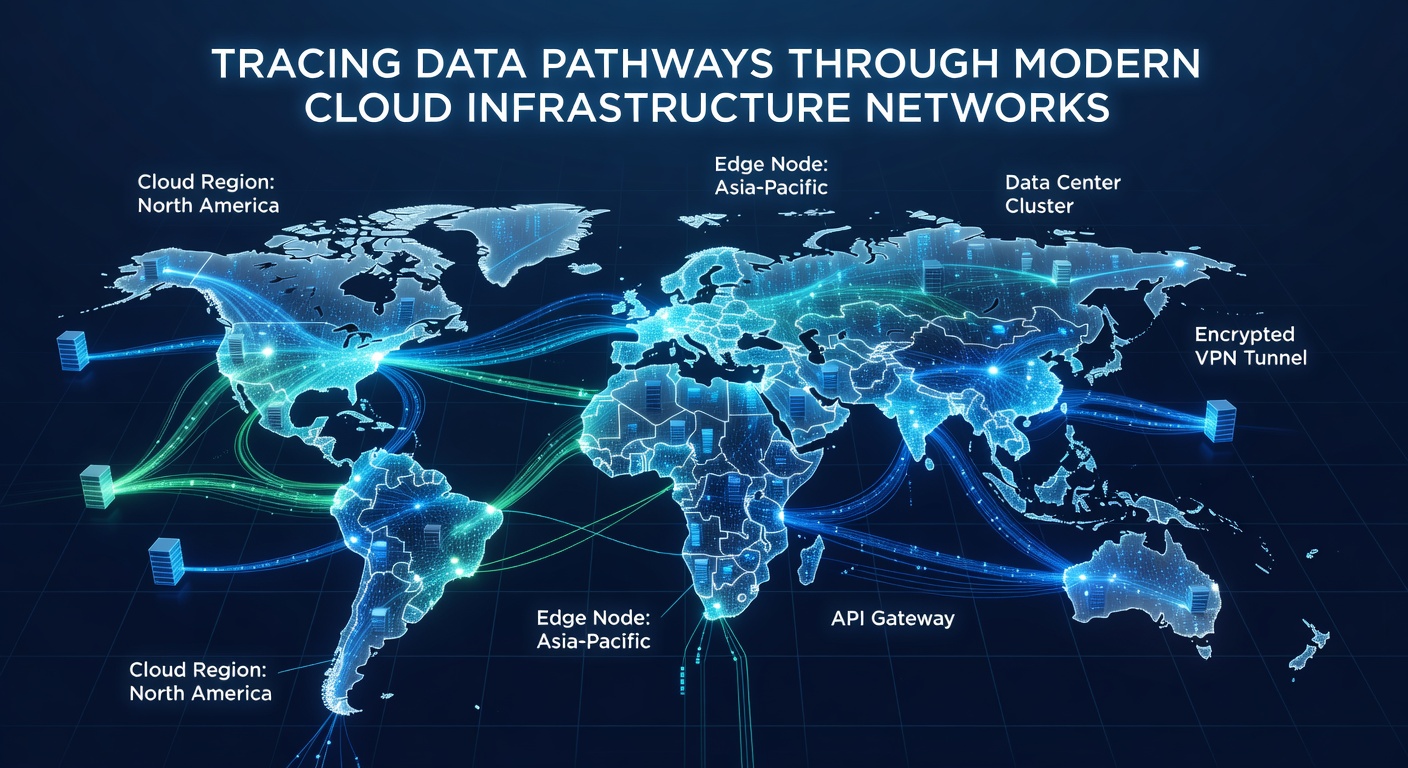
Organizations operating across AWS, Azure, and private data centers must reconcile differing logging formats and identity systems, and middleware solutions that normalize these formats have become common in large deployments. Data collected during May 2026 showed increased interest in unified observability platforms that ingest telemetry from all providers through standardized APIs, and this standardization reduces the time required to build end-to-end views.
Edge locations add further complexity because traffic may traverse last-mile networks before reaching core cloud regions, and specialized probes placed at peering points capture the additional latency introduced outside the provider's direct control. Studies found that monitoring these edge segments helps identify whether performance problems originate inside the cloud or in the broader internet path.
Security and Compliance Implications
Tracing capabilities support investigations into data exfiltration attempts by revealing unexpected outbound connections or unusual volume spikes on specific routes, and regulatory frameworks require evidence that sensitive information remains within approved geographic boundaries. According to documentation from the National Institute of Standards and Technology, organizations should implement continuous monitoring of network paths to demonstrate control over data location and access patterns.
Encryption at rest and in transit complicates inspection because payload contents remain hidden, yet metadata such as packet sizes and timing still provide useful signals for anomaly detection. Observers note that privacy-preserving analysis techniques allow teams to derive pathway statistics without decrypting individual flows, and these methods align with emerging data protection rules in multiple jurisdictions.
Future Directions in Pathway Visibility
Advances in programmable networking hardware enable deeper sampling at line rate, and this capability supports finer-grained reconstruction of short-lived connections that traditional five-tuple logging often misses. Industry reports from the Cloud Security Alliance indicate that integration of pathway data with automated remediation workflows will become standard practice as environments scale beyond manual oversight.
Academic research continues to explore graph-based representations that treat each network element as a node and each observed interaction as an edge, and these models facilitate queries about reachability and potential bottlenecks. Those who've studied this area know that maintaining accurate topology maps requires regular reconciliation between declared configurations and observed behavior.
Conclusion
Effective tracing of data pathways in cloud infrastructure depends on coordinated use of logs, traces, and flow records collected across every layer of the stack, and organizations that invest in these capabilities gain clearer pictures of how their systems actually operate under load. Continued evolution of standards and tooling promises to reduce the friction involved in assembling comprehensive views, while regulatory expectations continue to emphasize demonstrable control over information movement.