Quantum Processors Transforming Urban Traffic Optimization Across Global Cities
Written by Quinn Lange · Jul 23, 2026
Quantum Processors Transforming Urban Traffic Optimization Across Global Cities
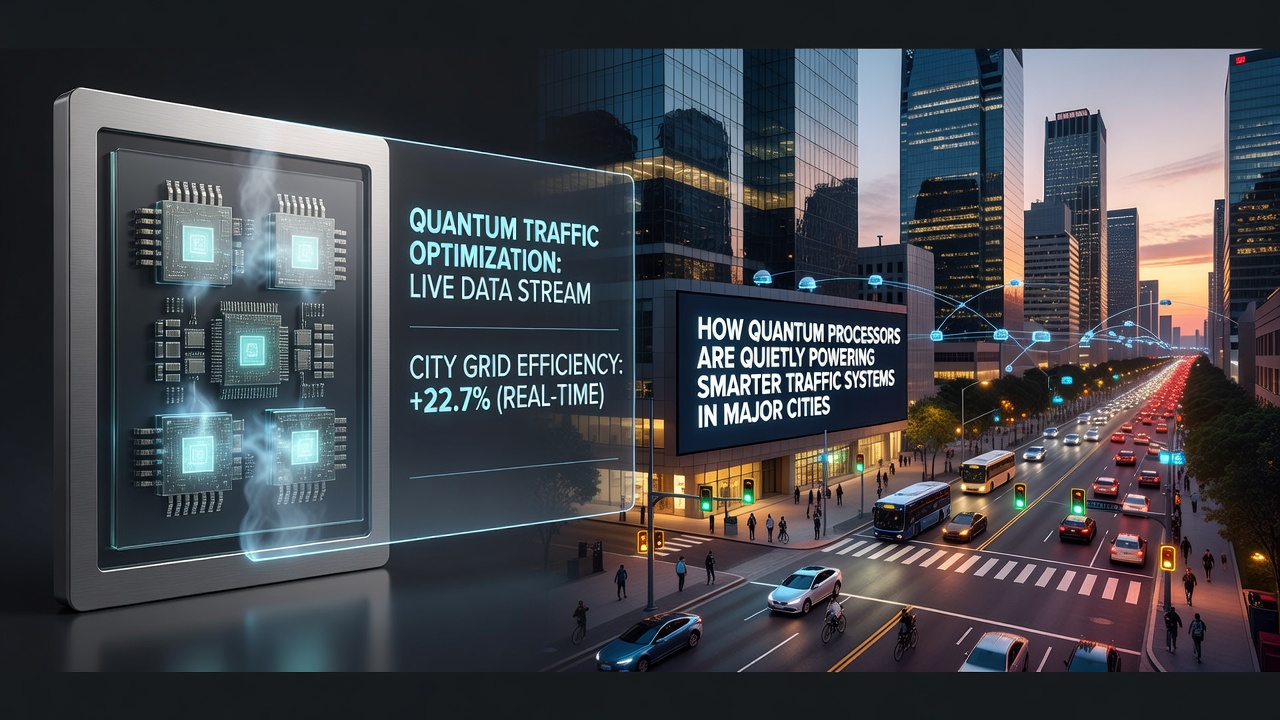
Quantum processors bring specialized computational capabilities to traffic management challenges that involve simultaneous optimization of thousands of variables such as vehicle routes, signal timings and congestion patterns, and cities worldwide have begun integrating these systems into existing infrastructure since early pilots demonstrated measurable improvements in flow efficiency. Researchers at institutions focused on applied quantum computing have noted that these processors handle combinatorial problems more effectively than classical supercomputers when data sets grow complex, which explains their quiet adoption in transportation departments seeking to reduce average commute times without major physical road expansions.
Core Mechanisms Behind Quantum Traffic Applications
Traffic systems rely on algorithms that minimize total travel time across networks while accounting for real-time inputs from sensors, cameras and connected vehicles, and quantum annealing techniques excel at finding near-optimal solutions for these large-scale routing tasks because they explore multiple configurations in parallel rather than sequentially. Data from deployments indicates that processing speeds for peak-hour simulations can increase by orders of magnitude compared with traditional methods, allowing operators to adjust signals dynamically as conditions evolve throughout the day. Observers note that hybrid quantum-classical setups often prove most practical at present, where quantum units tackle the hardest optimization subproblems and feed results back into conventional control software running on city servers.
Implementations Observed in Major Metropolitan Areas
Take Singapore's Land Transport Authority, which incorporated quantum-inspired optimization modules into its traffic command center several years ago and has since expanded testing to full quantum hardware access through cloud partnerships, resulting in documented reductions in expressway bottlenecks during rush periods. Similarly, authorities in Melbourne began evaluating quantum approaches for port-adjacent freight corridors in 2025, with further scaling reported through mid-2026 as integration with existing SCATS adaptive signaling platforms progressed. In July 2026, a coordinated trial across three North American cities including Toronto and Seattle demonstrated how shared quantum resources could model cross-border corridor flows, producing signal plans that cut average delays by double-digit percentages according to municipal engineering reports. European efforts have followed comparable paths, with Barcelona's municipal mobility team linking quantum solvers to its network of IoT traffic poles to handle event-driven surges such as concert or sports venue outflows more responsively than rule-based systems alone permitted.

Data Sources and Measured Outcomes
Figures released by the Federal Highway Administration show that participating agencies achieved higher throughput at monitored intersections after introducing quantum-assisted timing plans, although results vary depending on sensor density and data quality feeding the models. A separate analysis from Australia's Department of Infrastructure, Transport, Regional Development, Communications and the Arts highlights parallel gains in freight movement efficiency along major arterials where quantum routing reduced idling times and associated emissions. Those who've studied the implementations emphasize that success hinges on seamless data pipelines between roadside units and the quantum backend, since even small latency issues can offset computational advantages during live operations.
Technical Integration and Future Scaling Considerations
Engineers face the task of translating classical traffic graphs into formats suitable for quantum circuits or annealing hardware, which often requires custom encoding steps that preserve constraint relationships such as lane capacities and turning restrictions. Partnerships between municipal IT teams and quantum hardware providers have produced middleware layers that abstract these details, letting traffic engineers interact through familiar dashboards while the underlying processors handle intensive calculations. Research indicates that error mitigation techniques continue to improve, allowing longer coherence times that support more intricate multi-intersection optimizations without excessive recalibration cycles. As qubit counts rise and cloud access broadens, additional cities are expected to test these tools on secondary networks before full rollout, building confidence through staged validation against historical traffic data sets.
Conclusion
Quantum processors now contribute to smarter traffic systems by addressing optimization bottlenecks that limit conventional approaches, with documented programs active in Asia, Australia, North America and Europe providing concrete performance data. Continued refinement of hybrid architectures and expanded sensor networks will likely determine how widely these capabilities spread, yet current evidence shows measurable operational benefits where deployments have reached live environments.