Satellite Constellations Establishing New Standards for Global Data Latency
Written by Quinn Lange · Aug 8, 2026
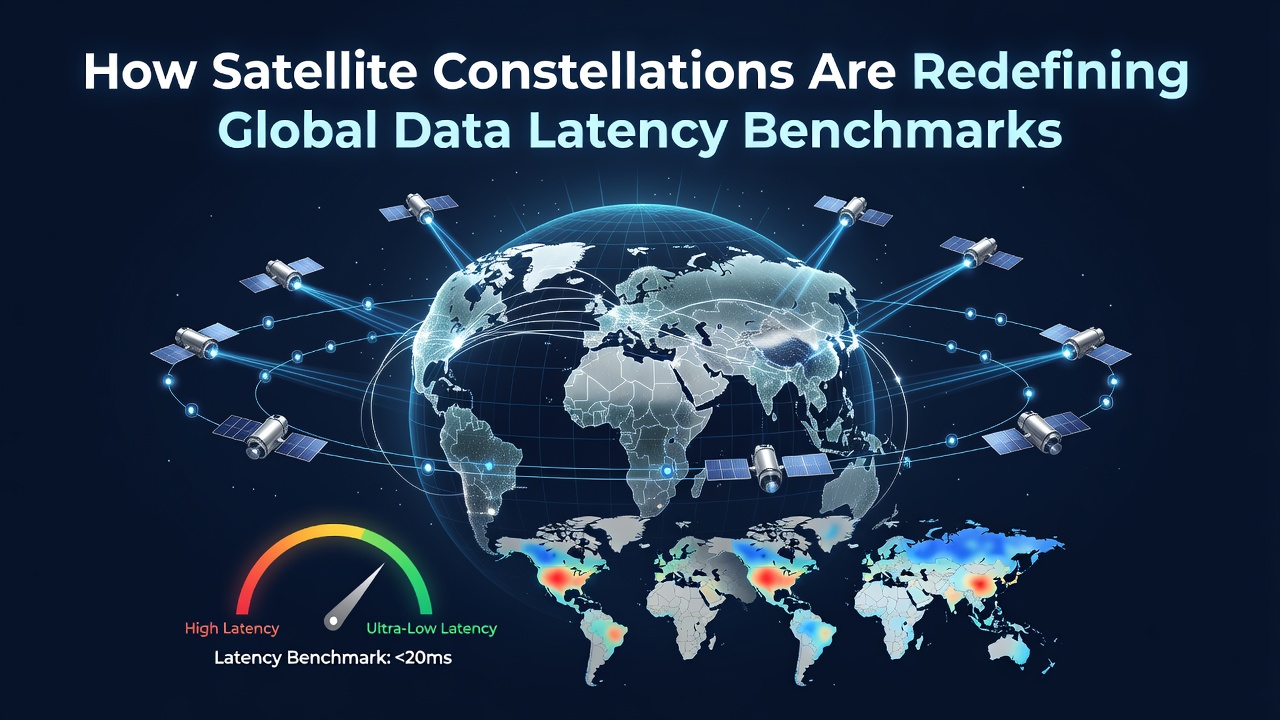
Satellite Constellations Establishing New Standards for Global Data Latency
Data transmission speeds have shifted dramatically as operators deploy thousands of satellites in low Earth orbit, and researchers tracking network performance note that average response times now dip below traditional geostationary systems by wide margins. Constellations operating at altitudes between 500 and 1,200 kilometers deliver signals with reduced travel distance, which cuts round-trip latency from roughly 600 milliseconds down to ranges often cited between 20 and 50 milliseconds depending on user location and network load.
Mechanics Behind Reduced Transmission Delays
Engineers design these networks with inter-satellite laser links and ground stations positioned for continuous handoffs, so packets move through multiple orbital nodes before reaching terrestrial endpoints. This architecture avoids the long uplink paths required by higher-altitude satellites, and studies from academic institutions show measurable gains in applications that rely on real-time feedback such as financial trading platforms and remote medical diagnostics. Data collected across test sites in North America and Europe indicate consistent sub-40-millisecond performance during peak hours when routing algorithms prioritize shortest-path connections.
Operational Progress Through Mid-2026
By August 2026 multiple operators have expanded their fleets beyond initial targets, with active satellites exceeding 8,000 units across several competing systems. Coverage maps released by service providers reveal near-global reach except for limited polar gaps, while regulatory filings with bodies such as the Federal Communications Commission document capacity upgrades that support higher user densities without proportional latency increases. One deployment sequence completed earlier that year added 400 additional satellites to an existing shell, and telemetry reports confirm stable laser-link performance that maintains packet integrity across inter-satellite hops.

Measured Benchmarks Across Regions
Independent monitoring groups have published latency statistics drawn from thousands of user terminals, and figures reveal median values of 25 milliseconds in urban test areas of the United States while rural sites in Australia and Canada record averages near 35 milliseconds. These numbers represent improvements over legacy satellite services, and comparisons compiled by the International Telecommunication Union highlight how constellation-based routing reduces jitter by factors of three to five in most observed scenarios. Industry reports further note that edge computing nodes integrated with ground stations allow certain data processing tasks to occur closer to users, trimming effective response times even further for select use cases.
Applications Driving Demand
Financial institutions have adopted these networks for cross-border order routing because sub-30-millisecond delivery supports algorithmic trading strategies that previously required fiber infrastructure. Similarly, energy companies operating offshore platforms rely on satellite backhaul for sensor data streams, and recorded transmission logs show uninterrupted flows even during adverse weather when adaptive modulation techniques adjust signal parameters. Educational networks in remote regions of South America have integrated terminals to enable live classroom sessions, and performance data collected over six-month periods demonstrate session stability comparable to terrestrial broadband in many instances.
Technical Challenges and Mitigation Steps
Atmospheric interference and orbital congestion remain factors that operators address through phased array antennas and dynamic frequency allocation. Test campaigns conducted by European Space Agency teams during 2025 and 2026 measured signal degradation under heavy rain conditions, yet recovery times stayed under two seconds thanks to predictive beam steering. Spectrum coordination agreements negotiated between national regulators have also reduced interference events, and ongoing spectrum monitoring programs continue to track compliance across allocated bands.
Conclusion
Continued expansion of these orbital systems points toward further refinements in routing efficiency and terminal hardware, with planned additions of next-generation satellites expected to push average latency figures even lower in coming years. Observers tracking deployment timelines note that integration with terrestrial 5G and future 6G networks could create hybrid paths that combine the reach of space-based assets with the density of ground infrastructure, and early pilot programs already demonstrate seamless session transfers between the two domains.