Sensor Fusion Driving Accuracy in Modern Portable Electronics
Written by Yara Washington · Jul 20, 2026

Sensor Fusion Driving Accuracy in Modern Portable Electronics
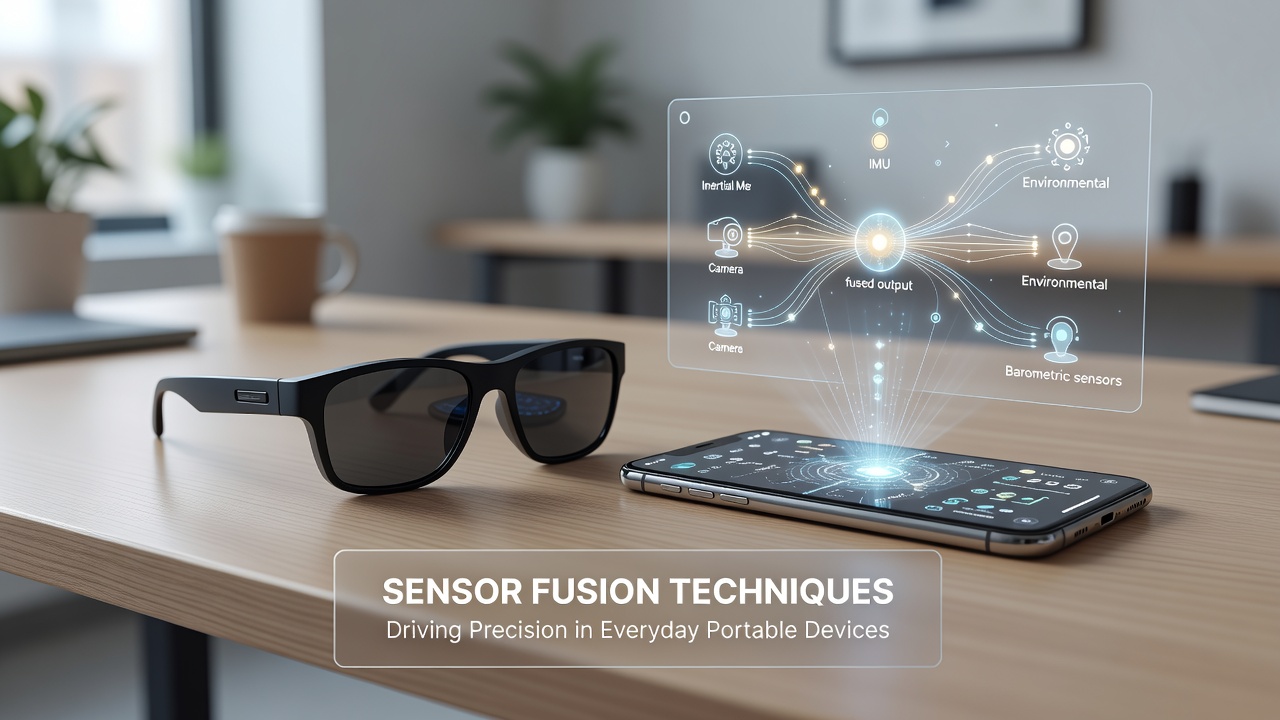
Portable devices rely on multiple sensors working together to deliver precise location tracking, motion detection, and environmental awareness, and sensor fusion combines data from accelerometers, gyroscopes, magnetometers, and GPS modules to reduce individual sensor errors while improving overall output reliability.
Core Techniques Behind Data Integration
Researchers apply algorithms such as Kalman filters, complementary filters, and particle filters to merge inputs in real time, and these methods weigh sensor reliability based on current conditions so that noisy readings from one source get corrected by steadier data from another. Studies from institutions in Canada and Australia show that fusion pipelines cut positioning drift by up to 70 percent during indoor navigation tasks where satellite signals weaken.
Engineers often layer additional approaches including Madgwick and Mahony filters for orientation estimation, and each technique processes quaternion-based calculations to handle rapid device rotations without accumulating large errors over extended use periods.
Applications Across Consumer Hardware
Smartphones integrate fused sensor streams to stabilize camera footage during handheld recording, and the same data streams power step counting plus fall detection in health applications. Wearable fitness bands combine heart-rate optical sensors with motion data to distinguish actual movement from artifacts caused by wrist shifts, which improves calorie estimates and activity classification accuracy.
Tablets and laptops now embed similar fusion stacks for automatic screen rotation plus precise stylus tracking, while automotive-grade chips adapted for portable use enable augmented-reality overlays that stay locked to real-world objects even when users move quickly through crowded spaces.
Performance Gains Documented in Recent Reports
Data collected by the National Institute of Standards and Technology indicates that fused inertial measurement units achieve sub-meter accuracy in controlled urban tests, whereas standalone GPS units frequently exceed three-meter errors under the same conditions. European research groups reported comparable results in a 2025 field study involving 500 participants carrying prototype devices across mixed indoor-outdoor routes.
Power consumption remains a key metric because continuous fusion processing draws extra current, yet optimized duty-cycling strategies allow modern chipsets to maintain high precision while extending battery life beyond previous generations. Observers note that firmware updates released in early 2026 further refined these trade-offs across flagship phone models.
Challenges and Ongoing Refinements
Temperature fluctuations, magnetic interference from nearby electronics, and user handling variations still introduce drift, and developers counter these issues through adaptive calibration routines that run silently in the background. A July 2026 industry workshop organized by the IEEE Sensors Council highlighted new machine-learning layers that detect and compensate for sudden environmental changes faster than traditional rule-based systems.
Supply-chain variations in sensor quality also affect fusion performance, prompting manufacturers to implement factory calibration plus over-the-air parameter tuning so that devices maintain consistent output despite component differences.
Future Directions Through 2026 and Beyond
Integration with emerging ultra-wideband radios and AI accelerators promises tighter synchronization between location and context awareness, and pilot programs already demonstrate centimeter-level tracking in controlled environments. Regulatory bodies in the United States and Japan continue to evaluate safety implications for medical-grade portable monitors that depend on fused sensor data for vital-sign accuracy.
Conclusion
Sensor fusion techniques now underpin reliable performance in everyday portable electronics by systematically combining complementary data streams, and continued algorithm improvements alongside hardware refinements point toward even greater precision in upcoming device generations.