The Integration of AI Model Training Techniques with Hardware Accelerators Designed for Edge Environments
Written by Iris Koch · Jun 15, 2026

The Integration of AI Model Training Techniques with Hardware Accelerators Designed for Edge Environments
Specialized hardware accelerators have become central components in systems that perform AI model training tasks closer to data sources rather than relying exclusively on centralized facilities, and researchers continue to examine how these chips interact with distributed training pipelines. Data centers traditionally handle large-scale model development yet edge environments now incorporate tensor processing units and neural processing units that support quantized operations along with gradient computations during localized updates.
Hardware vendors release accelerators with architectures optimized for both inference workloads and incremental training steps, which allows models to adapt based on incoming sensor streams without constant cloud round-trips. In June 2026 industry reports highlighted deployments where automotive and manufacturing sites ran federated learning rounds on accelerator-equipped gateways, and the resulting model improvements occurred while maintaining strict latency bounds.
Hardware Architectures Supporting On-Device Training
Modern edge accelerators integrate systolic arrays and dedicated matrix engines that accelerate backpropagation calculations at reduced precision levels, and these designs balance power consumption against throughput when processing batches collected from local cameras or industrial sensors. Engineers configure memory hierarchies to keep activation maps and weight gradients in on-chip SRAM, which reduces external DRAM accesses during training iterations.
Companies such as those supplying automotive-grade silicon have introduced chips that combine general-purpose cores with AI-specific blocks, enabling simultaneous execution of data preprocessing routines and model update steps. Observers note that this integration shortens the time required to incorporate new examples into deployed models while staying within thermal envelopes typical of outdoor enclosures.
Training Methodologies Adapted for Edge Constraints
Federated learning frameworks distribute gradient aggregation across edge nodes equipped with accelerators, and participants perform local epochs before sending compressed updates to a central server. Techniques such as differential privacy and secure aggregation protect intermediate results during transmission, while accelerator firmware supports the necessary encryption and compression primitives in hardware.
Knowledge distillation approaches further reduce the computational load by training smaller student models on edge devices using outputs from larger teacher models hosted remotely, and accelerators optimized for low-bit arithmetic deliver the required matrix multiplications at acceptable energy costs. Studies from academic groups in Canada and Australia document accuracy retention rates above ninety percent when these methods operate on resource-limited nodes.
Performance Metrics and Deployment Patterns
Benchmarks released by research institutions show that edge accelerators achieve training throughput measured in tera-operations per second while drawing under fifteen watts, and these figures enable continuous model refinement in solar-powered installations. Latency measurements indicate that a single local training round completes in under two hundred milliseconds when batch sizes remain modest, which supports applications requiring rapid adaptation to environmental changes.
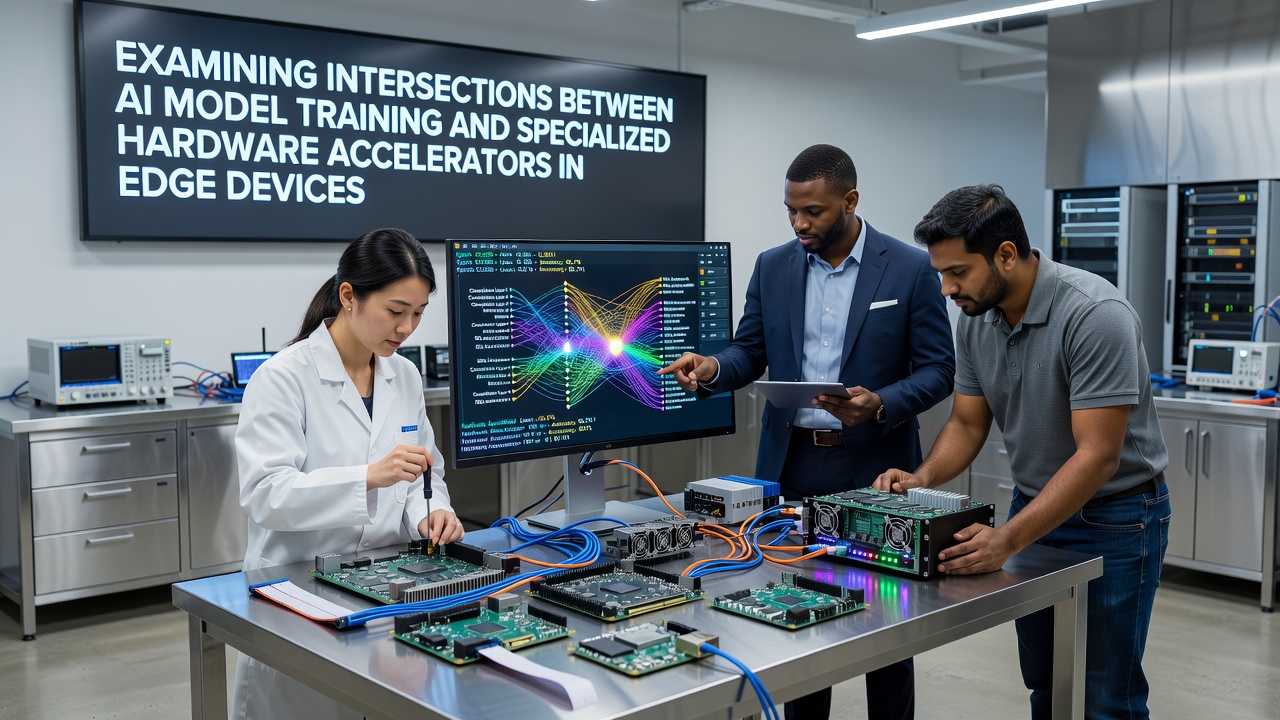
Deployment patterns vary by sector: logistics operators place accelerators inside warehouse scanners to refine object detection models on-site, whereas healthcare facilities use similar hardware in diagnostic equipment to personalize analysis algorithms based on patient cohorts. Data from the National Institute of Standards and Technology indicates that standardized interfaces for accelerator programming have accelerated adoption across these verticals.
Software Ecosystems and Framework Support
Machine learning frameworks now include backends that target edge accelerators directly, allowing developers to partition computation graphs so that training subgraphs execute locally while heavier operations remain in the cloud. Runtime schedulers allocate tasks according to available memory bandwidth and thermal headroom, and these decisions occur automatically during model compilation.
European research consortia have contributed open specifications that define how accelerators expose training capabilities to higher-level libraries, and compliance testing ensures interoperability across vendors. The result appears in unified codebases that run unchanged from prototype boards to production gateways.
Security Considerations During Localized Training
Edge accelerators incorporate hardware roots of trust that verify model weights and training code before execution begins, which reduces risks associated with tampering at remote sites. Memory protection units isolate training buffers from other processes running on the same system-on-chip, and secure boot sequences establish trusted execution environments for gradient calculations.
Organizations in the Asia-Pacific region have published guidelines that align accelerator features with data residency requirements, ensuring that sensitive training data never leaves designated geographic boundaries during model updates. These measures complement existing encryption standards already embedded in communication stacks.
Conclusion
The intersection between AI model training and specialized hardware accelerators continues to expand as edge deployments mature, with documented cases demonstrating feasible on-device updates that maintain model relevance without excessive infrastructure demands. Continued standardization efforts and cross-regional collaboration point toward broader integration of these technologies in coming years.