The Silent Revolution in Battery Tech That's Powering Tomorrow's Wearables
Written by Katja Albrecht · May 21, 2026

The Silent Revolution in Battery Tech That's Powering Tomorrow's Wearables
Developments in battery technology continue to reshape how wearable devices operate, with researchers focusing on higher energy density, flexible form factors, and longer operational lifespans that match the demands of continuous health monitoring and connectivity features. Data from industry reports show that global shipments of smartwatches and fitness trackers exceeded 250 million units in 2025, driving manufacturers to seek power solutions beyond traditional lithium-ion cells that often limit device thickness and runtime.
Engineers at multiple laboratories have advanced solid-state battery designs that replace liquid electrolytes with ceramic or polymer materials, reducing risks associated with leakage while allowing thinner profiles suitable for wristbands and smart rings. Studies published in 2025 documented energy densities reaching 400 watt-hours per kilogram in prototype cells, a notable increase from the 250 to 300 watt-hours per kilogram common in consumer electronics just a few years earlier, and these gains translate directly into multi-day usage without recharging for many wearable models.
Key Materials Driving Efficiency Gains
Graphene and silicon anode integrations feature prominently in recent prototypes, where researchers combine these materials to minimize swelling during charge cycles and extend cycle life beyond 1,000 full charges. Figures from the U.S. Department of Energy highlight pilot production lines that achieved 15 percent higher capacity retention after 800 cycles compared with conventional graphite-based cells, supporting the needs of medical-grade wearables that track heart rhythms and blood oxygen levels around the clock.
Flexible thin-film batteries represent another active area, with companies in Japan and South Korea scaling manufacturing processes that deposit active layers onto polymer substrates. These designs bend without performance loss, enabling integration into clothing and patches that conform to skin surfaces, and test data indicate stable output even after 10,000 flex cycles at varying temperatures.
Energy Harvesting Integration
Many current projects combine rechargeable cells with energy harvesting elements such as photovoltaic films or thermoelectric generators that capture body heat or ambient light. Observers note that hybrid systems tested in 2025 prototypes delivered up to 20 percent of daily power requirements from environmental sources alone, reducing reliance on wall charging and extending usability during extended outdoor activities.
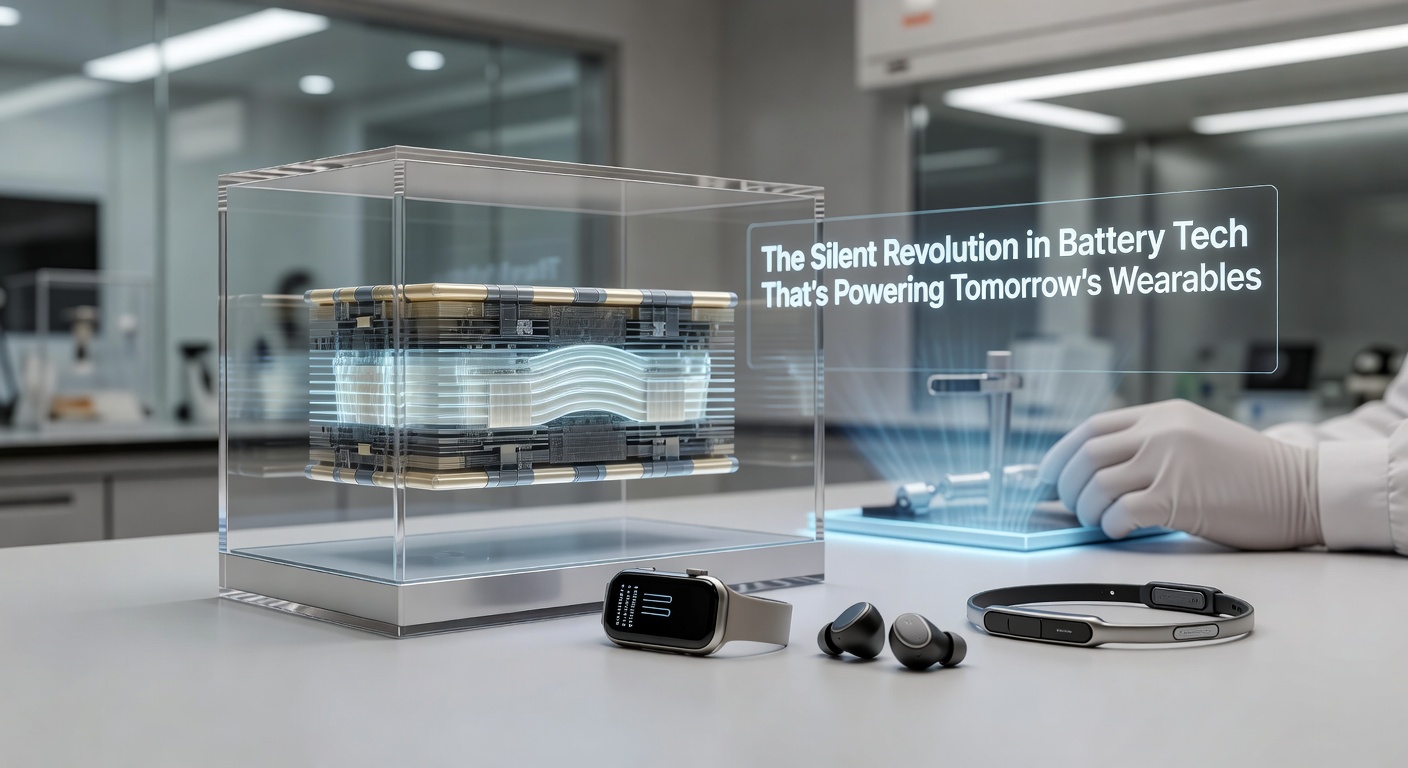
European research consortia, including work coordinated through Fraunhofer institutes, reported successful trials of micro-supercapacitors paired with primary cells to handle peak loads from wireless transmissions. These pairings maintain voltage stability during data uploads while keeping overall device volume under 2 cubic centimeters, a size constraint critical for earbuds and AR glasses that users wear for hours without discomfort.
Timeline of Recent Milestones
By early 2026 several manufacturers had begun limited commercial releases of wearables containing these upgraded cells, with reported runtimes averaging 72 hours on a single charge under mixed usage conditions. Australian university teams documented similar results in field studies involving athletes, where continuous biometric recording remained uninterrupted across multi-day events without external power input.
Regulatory bodies in Canada and the European Union continue to evaluate safety standards for these new chemistries, focusing on thermal runaway thresholds and recyclability requirements that differ from legacy battery types. Compliance documentation released in spring 2026 outlined testing protocols that simulate real-world drop impacts and humidity exposure, confirming that updated cells meet existing transport and consumer safety thresholds.
Applications Across Device Categories
Medical wearables benefit directly from the improved capacity and form flexibility, allowing continuous glucose monitors and ECG patches to operate for weeks between replacements. Data collected through clinical trials show reduced data gaps during sleep and exercise periods, supporting more accurate trend analysis for healthcare providers.
Consumer fitness trackers incorporate the same advances to add always-on displays and multi-sensor arrays without increasing device bulk. Production figures from supply chain analyses indicate that shipments of flexible battery modules grew 35 percent year-over-year through the first quarter of 2026, reflecting broader adoption across mid-range and premium product lines.
Future Development Pathways
Research teams worldwide explore lithium-metal and sodium-ion variants that promise further cost reductions and raw material availability improvements. Laboratory results presented at international conferences in May 2026 demonstrated sodium-based pouch cells achieving 300 watt-hours per kilogram while using abundant materials that lower supply chain vulnerabilities compared with cobalt-dependent formulations.
Integration challenges remain around manufacturing yield and interface compatibility with existing electronics, yet collaborative efforts between material suppliers and device assemblers continue to narrow these gaps through iterative testing cycles. Progress in these areas supports expectations that battery constraints will become less limiting for the next wave of wearable innovations.
Conclusion
Advances in battery architecture, materials science, and hybrid power systems collectively enable wearables that deliver extended performance within compact, comfortable designs. Ongoing work across academic, governmental, and industrial settings continues to refine these technologies, positioning them to meet rising demands for seamless health tracking and connected experiences in daily life.