Tracing Processor Architecture Changes for Machine Learning Applications
Written by Ulrich Koch · Jun 25, 2026
Tracing Processor Architecture Changes for Machine Learning Applications
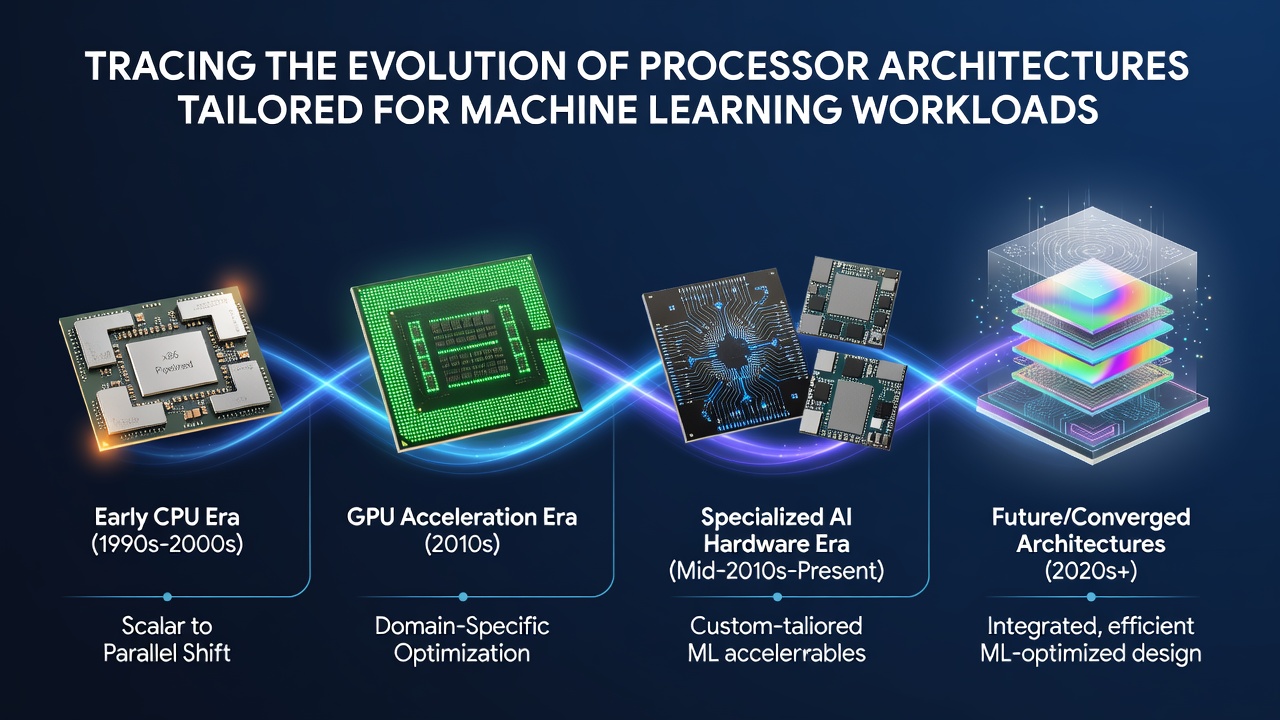
Processor designs began shifting toward machine learning needs once data volumes and model complexities outgrew the capabilities of traditional central processing units, and researchers started exploring parallel execution paths that could handle matrix operations more efficiently while maintaining accuracy across large datasets.
Initial Reliance on Standard Computing Hardware
Early machine learning experiments depended on general purpose CPUs that executed instructions sequentially, yet these chips delivered acceptable results for small scale neural network training until dataset sizes expanded rapidly in the 2000s, at which point performance bottlenecks became evident and prompted hardware specialists to examine alternative execution models that emphasized simultaneous calculations over single thread speed.
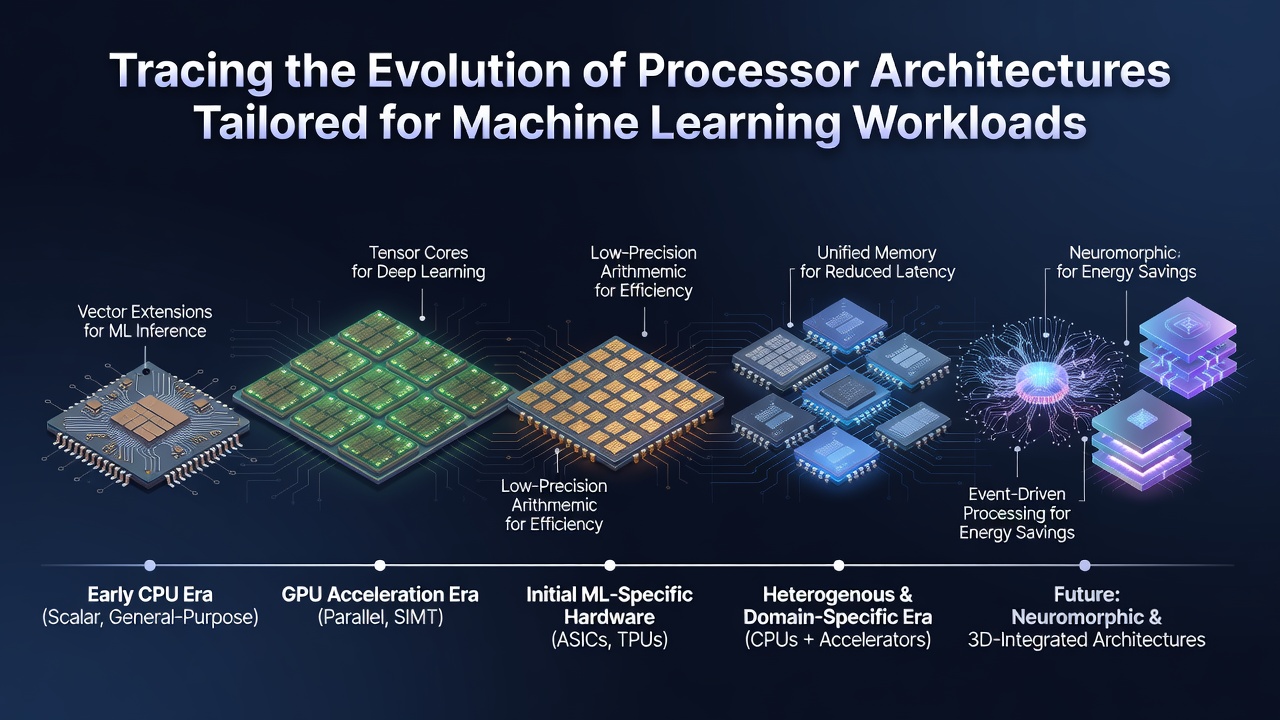
Studies conducted at various academic institutions revealed that vector processing extensions already present in some CPU lines offered modest improvements, and developers began optimizing software libraries to exploit those features more fully, although the underlying silicon remained oriented toward broad computing tasks rather than the repetitive arithmetic patterns typical of training algorithms.
Adoption of Graphics Processing Units for Parallel Workloads
Graphics processing units entered the picture when engineers recognized that their thousands of lightweight cores could accelerate the matrix multiplications central to neural network training, and by the mid 2010s frameworks such as CUDA had matured enough to let researchers map machine learning operations directly onto GPU hardware without extensive custom coding.
Data from industry benchmarks showed training times dropping from weeks to days for models like convolutional networks used in image recognition, while power efficiency metrics improved because the same computational throughput required fewer physical servers compared with CPU only clusters, and this efficiency gain encouraged cloud providers to expand GPU based offerings.
Emergence of Purpose Built Accelerators
Companies developed tensor processing units and similar application specific integrated circuits once the volume of inference and training requests justified the expense of custom silicon, and these chips incorporated systolic arrays optimized for the exact dataflow patterns found in deep learning models, which reduced instruction overhead and improved energy use per operation.
According to reports from the National Science Foundation, funding for domain specific architectures increased steadily through the 2020s, supporting university research into reconfigurable fabrics that could adapt between training and inference phases without full hardware redesigns, and those projects influenced commercial offerings that appeared in data centers worldwide.
European research consortia under Horizon Europe programs documented similar trends, noting that hybrid systems combining traditional CPUs with dedicated accelerators delivered the best balance of flexibility and performance for mixed workloads that included both machine learning and conventional analytics.
Integration at the Edge and Future Scaling Trends
Neural processing units began appearing inside mobile and embedded devices as model compression techniques allowed smaller networks to run locally, and this shift reduced reliance on constant cloud connectivity while lowering latency for applications such as real time language translation and object detection in autonomous systems.
By June 2026, multiple foundries had announced process nodes below three nanometers that incorporated additional on chip memory to keep weights closer to compute elements, thereby cutting data movement energy costs that had previously limited model size growth, and early test chips demonstrated sustained throughput improvements without proportional increases in power draw.
Observers note that software toolchains evolved alongside the hardware, with compilers now generating code that targets mixed precision arithmetic units automatically, which allows developers to maintain model accuracy while taking advantage of lower bit width operations that newer architectures support natively.
Conclusion
The progression from general purpose processors through graphics accelerators to fully specialized tensor engines reflects a consistent response to the computational characteristics of machine learning workloads, and ongoing refinements in both silicon design and accompanying software continue to shape how these systems scale to meet expanding application demands across research, industry, and consumer devices.