Tracing the Evolution of Open Source Frameworks That Power Modern Machine Learning Workloads on Distributed Systems
Written by Yara Washington · Jun 27, 2026
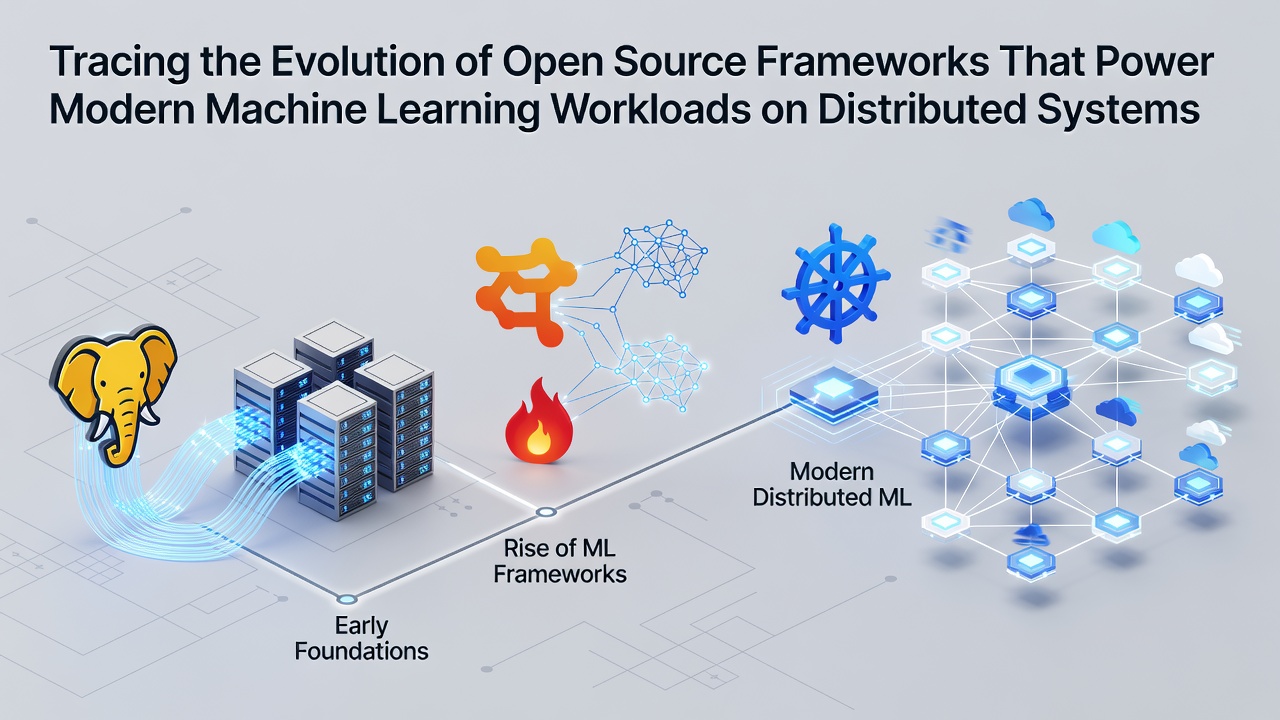
Tracing the Evolution of Open Source Frameworks That Power Modern Machine Learning Workloads on Distributed Systems
Developers began building open source tools for distributed computing long before machine learning workloads demanded massive scale, and early projects like the Message Passing Interface libraries from the 1990s laid groundwork that later frameworks expanded into data-parallel training environments. Researchers at academic institutions and national laboratories collaborated on these initial systems because single machines could not handle growing datasets from scientific simulations or early web archives.
Foundations in Distributed Data Processing
Apache Hadoop emerged around 2006 as one of the first widely adopted open source platforms capable of storing and processing terabytes across commodity clusters, and its MapReduce paradigm influenced subsequent machine learning libraries that needed to iterate over large feature sets. Engineers quickly adapted Hadoop's file system and job scheduler for basic statistical models, yet performance bottlenecks with iterative algorithms prompted new designs. Apache Spark arrived in 2010 from researchers at UC Berkeley and introduced in-memory processing that accelerated gradient descent and other repeated operations common in training routines. Data shows Spark's resilient distributed datasets reduced job times dramatically compared with disk-bound predecessors, while its integration with libraries such as MLlib allowed practitioners to run classification and clustering tasks without leaving the same execution engine.
Rise of Specialized Machine Learning Runtimes
TensorFlow appeared in 2015 after internal development at Google, and its graph-based execution model supported both single-node prototyping and multi-node training through built-in distribution strategies. PyTorch followed shortly afterward from Facebook's AI research group, offering dynamic computation graphs that many researchers found more intuitive for experimentation before scaling models across GPUs. Both frameworks released open source code under permissive licenses, which encouraged contributions that added support for collective communication libraries such as NCCL and later MPI backends. Observers note that the competition between these ecosystems accelerated feature development, including automatic mixed precision and pipeline parallelism techniques now standard in production deployments.
Modern Orchestration and Scaling Layers
Kubernetes gained traction as the de facto container orchestration platform during the late 2010s, and projects such as Kubeflow extended it with custom resources for distributed training jobs that span multiple nodes with fault tolerance. Ray, introduced by the same UC Berkeley group behind Spark, provided a unified interface for both task scheduling and actor-based model serving, allowing teams to manage reinforcement learning workloads alongside batch inference without separate clusters. Dask offered similar Python-native parallelism for users already invested in pandas and scikit-learn workflows, while its integration with Kubernetes operators enabled seamless scaling when dataset sizes exceeded single-machine memory. Figures from industry reports indicate that by 2024 more than half of surveyed organizations ran at least one production machine learning pipeline on these layered open source stacks rather than proprietary alternatives.
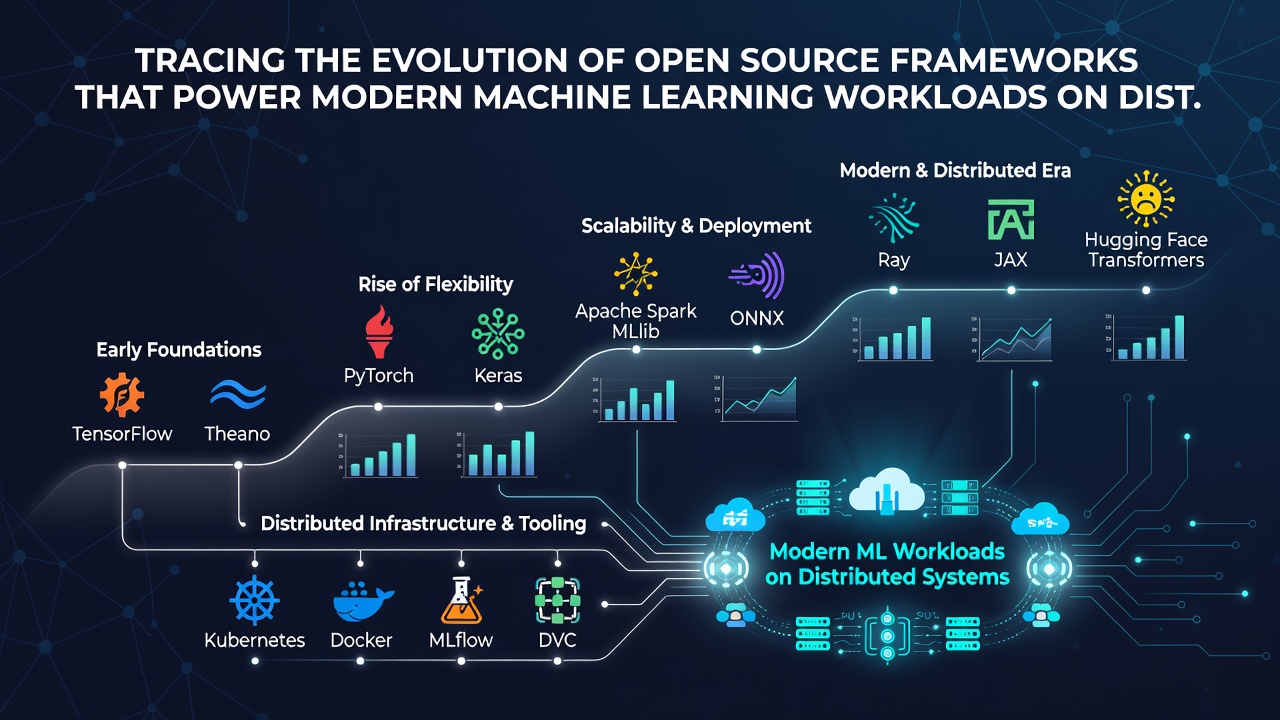
Additional libraries such as Horovod and DeepSpeed layered on top of existing frameworks to optimize communication patterns during all-reduce operations, and their adoption grew after benchmarks demonstrated near-linear scaling on clusters exceeding one hundred accelerators. Government-funded initiatives including those supported by the National Science Foundation have documented performance characteristics of these tools across heterogeneous hardware, providing public datasets that guide further optimization. In June 2026 several maintainers plan coordinated releases that incorporate tighter integration between Ray clusters and Kubernetes gateway APIs, aiming to simplify multi-tenant resource allocation for research groups sharing large GPU pools.
Current Capabilities and Ongoing Standardization Efforts
Standards bodies and academic consortia continue refining interfaces that let frameworks interoperate more cleanly, for example through common checkpoint formats and telemetry schemas. European research networks have contributed reference implementations that emphasize energy-aware scheduling, while Canadian academic centers focus on privacy-preserving extensions compatible with federated learning workloads. These parallel efforts converge in open source repositories where contributors test compatibility across cloud providers and on-premises installations. The result is an ecosystem where a single training script can target different hardware backends with minimal code changes, supported by mature debugging and profiling utilities released under the same open licenses.
Conclusion
Tracing these developments reveals a consistent pattern of academic prototypes maturing into production-grade tools through community iteration and cross-project collaboration. Distributed systems once designed for general data processing now incorporate specialized primitives for gradient synchronization, model sharding, and elastic scaling. Continued contributions from diverse geographic regions ensure the frameworks remain adaptable as hardware architectures and workload patterns evolve beyond current GPU-centric designs.